
Is Beeswax Safe for Food? What You Need to Know
Table of Contents
- Is Beeswax Safe for Food? The Short Answer
- What Is Food-Grade Beeswax and How Is It Labeled?
- Beeswax for Cutting Boards and Wooden Utensils
- Beeswax Wraps Food Safety: What to Know
- Beeswax vs. Mineral Oil for Cutting Boards
- Beeswax in Food: Edibility, Digestion, and Common Questions
- How to Choose a Safe Beeswax Wood Finish
- Frequently Asked Questions
Last Updated: October 16, 2026
Is Beeswax Safe for Food? The Short Answer
Yes, beeswax can be suitable for food-contact applications when it is appropriately processed and intended for that use. In the United States, beeswax appears in FDA food-contact regulations, but that does not mean every beeswax product is automatically suitable for kitchen or food-contact use.
Here's the distinction most articles skip: food-contact safe, food-grade, and edible are three different things. A wax can be safe to touch your food and still not be something you'd eat by the spoonful.
What Is Food-Grade Beeswax and How Is It Labeled?
Food-grade beeswax is refined and filtered to meet purity standards for food-contact use. Raw honeycomb wax carries debris, pollen, and hive residues; refining removes those so the wax suits food packaging, candy glazes, fruit coatings, and cutting board conditioners.
"Food-grade" is not a single government stamp. It is a supplier claim, backed by different things depending on where the wax was produced and how it was processed.
What the U.S. Regulation Actually Says
In the United States, beeswax is listed as an indirect food additive in the FDA's Code of Federal Regulations. The relevant entry is 21 CFR 178.3720, Synthetic paraffin and succinic derivatives, the section where beeswax appears among permitted substances for use on food-contact surfaces.
What that listing does not do:
- It does not certify any specific batch of wax.
- It does not set a purity threshold a supplier must test against.
- It does not require a label to say "food-grade."
So when a product says "food-grade beeswax," the claim rests on the supplier's own refining and testing, not on a government inspection of that jar.
What E901 Means, and What It Doesn't
The E901 designation on some imported products is the European food additive code for beeswax. It signals the wax is permitted as a food additive in the EU, which evaluates additives under a different framework than the U.S. system.
E901 is useful shorthand, but it is not an American certification and does not mean the wax in front of you was tested for pesticide residues or heavy metals.
Food-Grade vs. Cosmetic-Grade vs. Craft-Grade
These three grades are refined differently and tested against different standards:
Grade |
Intended use |
Typical filtering |
What it does not guarantee |
|---|---|---|---|
Food-grade |
Food contact, food packaging, edible coatings |
Fine filtration, residue removal |
Batch-level contaminant testing unless the supplier states it |
Cosmetic-grade |
Skin contact, balms, lotions, salves |
Moderate filtration |
Suitability for ingestion or food contact |
Craft-grade |
Candles, furniture polish, hobby use |
Minimal filtration |
Any food-contact suitability |
If a product does not state that it is intended for food-contact use, do not assume that it is suitable for kitchen wood. A wax fine for a lip balm is not automatically fine for a surface your bread rests on.
Reading Labels and Safety Data Sheets
A safety data sheet, often called an SDS or MSDS, tells you how a product should be handled, what is in it, and what hazards apply. For a wood finish, look for:
- A full ingredient list, not a vague "natural waxes" catch-all
- A food-contact statement from the maker
- Solvent content, since some finishes use petroleum solvents that need to fully cure before food contact. If unsure, it is best to avoid petroleum based products like mineral oil.
If the maker does not clearly disclose the ingredients, intended use, or food-contact suitability, choose a product that does.
Questions to Ask About Purity and Testing
Because "food-grade" is a supplier claim, ask directly:
- Is the wax filtered, and to what level?
- Is it tested for pesticide residues or heavy metals, and can you share results?
- Is it blended with anything else, carrier oils, solvents, dyes, fragrance?
A supplier who answers these clearly beats one leaning on the word "natural." Natural does not mean tested, and it does not mean food-safe.
Beeswax for Cutting Boards and Wooden Utensils
Beeswax suits cutting boards and wooden utensils because it helps seal the grain, slows moisture uptake, and leaves a finish safe on food-contact surfaces. It's a conditioner and protective finish, not a sanitizer.
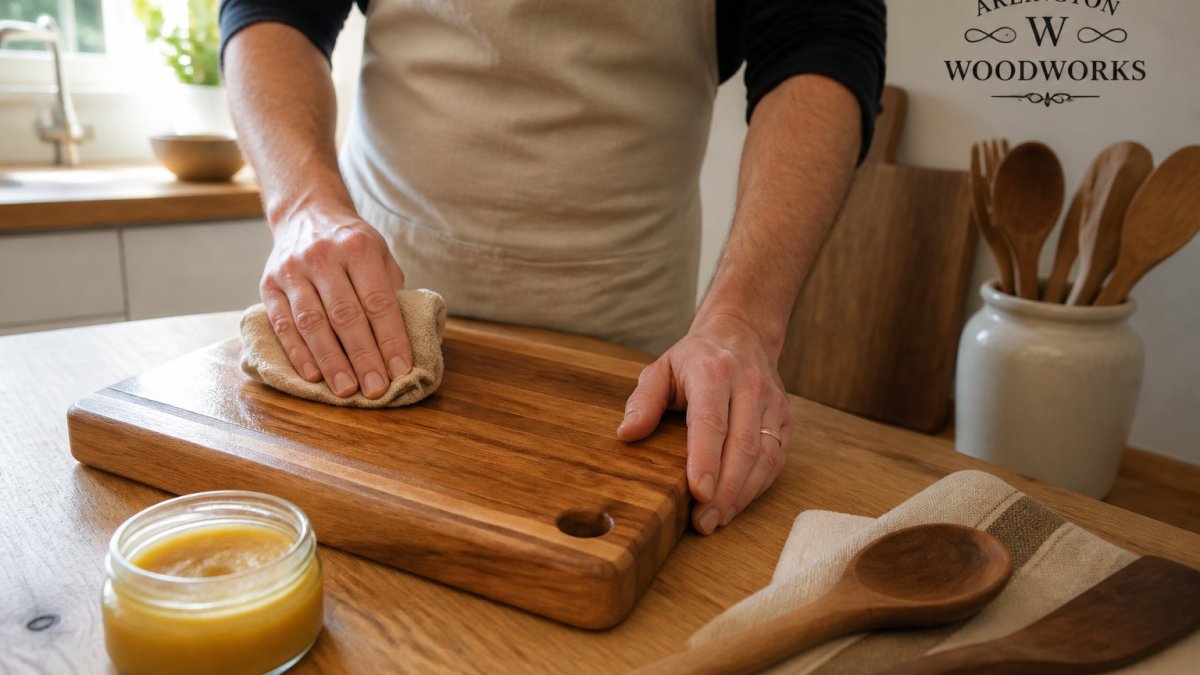
Before you buy anything, sort out whether your board is a removable cutting board or an installed butcher-block countertop, and whether the wood is bare, oil-finished, or sealed under a film finish like polyurethane.
How to Apply Beeswax to a Cutting Board
Applying beeswax to a cutting board takes about ten minutes and no special skill:
- Start with a clean, completely dry surface.
- Test a hidden area first to confirm the finish responds well.
- Scoop a small amount of balm and apply it in circular motions.
- Let it absorb for a few minutes.
- Buff away all excess with a clean cloth.
A little goes a long way, and proper buffing leaves no residue.
At Arlington Woodworks, our Artisan Furniture Wood Balm No. 524 follows this routine. It's made with certified-organic flaxseed oil, beeswax, and orange oil, and it's appropriate for cutting boards, butcher blocks, wooden utensils, and kitchen wood when used as directed.

Beeswax Wraps Food Safety: What to Know
Beeswax wraps are cotton fabric coated in beeswax, often blended with a carrier oil such as jojoba or coconut oil.
Where wraps get tricky is care and lifespan. For food-safety guidance on washing and sanitizing anything that touches food, the CDC's guidance on cleaning and sanitizing surfaces is a solid reference point.
One honest limitation: beeswax wraps are not a seal. They don't create an airtight barrier, so they're not the right choice for long-term freezer storage or raw meat.
Beeswax vs. Mineral Oil for Cutting Boards
Beeswax and mineral oil both condition cutting boards, but they behave differently, and the better pick depends on the finish you want.
Mineral oil is a liquid that soaks deep into wood and is a common choice for a bare cutting board.
Beeswax sits closer to the surface, adding a soft protective film that repels water and slows drying.
Feature |
Mineral Oil |
Beeswax Finish |
|---|---|---|
Form |
Liquid |
Solid balm |
Depth of penetration |
Deep |
Surface plus some penetration |
Surface protection |
Minimal |
Soft protective film |
Reapplication frequency |
Frequent |
Less frequent |
Best for |
Bare boards needing deep conditioning |
Boards and utensils needing surface protection |
Food contact |
Yes, when food-grade (use caution) |
Yes, when food-grade |
Many woodworkers use both: mineral oil first to condition deeply, then a beeswax balm on top to seal.
Beeswax in Food: Edibility, Digestion, and Common Questions
Beeswax is used in some food applications, but food-contact suitability and intentional ingestion are different questions. For kitchen wood, the relevant question is whether the finished product is intended for food-contact use.
What Happens When You Swallow Beeswax
Humans cannot fully digest beeswax. It is a mixture of long-chain fatty acids, hydrocarbons, and esters that human digestive enzymes do not break down efficiently, so most passes through largely unchanged.
Small amounts are considered non-toxic. That is not a green light to eat wax by the handful, nor a reason to treat a beeswax-finished cutting board as a food source.
Food-Contact Safe vs. Food-Grade vs. Edible
These three terms get used interchangeably, and they should not be:
- Food-contact safe, the material is suitable for surfaces that touch food. This is the standard a cutting board finish needs to meet.
- Food-grade, the material has been refined and handled to a purity standard intended for food use. Food-grade wax is usually food-contact safe, but the reverse is not automatic.
- Edible, the material is intended to be eaten. Beeswax qualifies in small amounts, but most food-contact applications do not require edibility.
For kitchen wood, you want a finish that is food-safe and made with food-grade ingredients. Edibility only becomes the deciding question if the wax is going into food, not onto a board.
Safe Use by Application and Exposure
How much beeswax you actually encounter depends entirely on how it is used:
Use |
Exposure level |
Practical note |
|---|---|---|
Beeswax wrap over a bowl |
Incidental, trace transfer only |
Safe when the wrap uses food-grade wax |
Beeswax-finished cutting board |
Incidental, trace transfer to food |
Safe when the finish is food-grade and fully buffed |
Candy coating or fruit glaze |
Deliberate ingestion, small amount |
Permitted as a food additive |
Eating wax directly |
Deliberate ingestion, larger amount |
Not recommended; no nutritional benefit |
For hot or acidic foods, the guidance matches any food-contact finish: keep the surface in good condition, avoid pooling wax, and follow the finish maker's directions. A well-buffed, fully cured finish transfers very little to food. Avoid a thick, tacky layer of excess wax, not because the wax is unsafe, but because it was applied incorrectly.
Contaminants and Why the Grade Exists
Processing and quality controls can reduce impurities, but the supplier’s specifications and testing are what establish suitability for food-related use.
If you are sourcing wax for anything food-related, buy from a supplier who states the grade and backs it up with testing information. "Natural" and "pure" are not the same as "tested."
Who Should Be More Careful
For most people, incidental exposure to food-grade beeswax is not a concern. Be more conservative if you are feeding young children, if someone in the household has a compromised immune system, or if you have a known sensitivity to bee products. In those cases, stick to clearly labeled food-grade products and follow the maker's directions.
A Note on Beeswax Wraps and Long-Term Storage
Beeswax wraps are a food-contact application, not an edible one. They are fine for covering bowls, wrapping sandwiches, and storing cheese. They are not a seal, so they are not the right choice for long-term freezer storage or raw meat. For washing and sanitizing anything that touches food, the CDC's guidance on cleaning and sanitizing surfaces is a solid reference point.
How to Choose a Safe Beeswax Wood Finish
Choose a beeswax wood finish by its ingredient list, its food-contact statement, and its intended use, in that order. Price and packaging come last.
Run every candidate through this checklist:
- Ingredients are listed in full, with no "fragrance" or "natural waxes" catch-all
- The maker states the finish is food-safe for food-contact surfaces
- There are no petroleum solvents or synthetic waxes
Arlington Woodworks makes this list short on purpose. No. 524 uses three ingredients, comes in recyclable glass packaging, and is made in small batches by a veteran-owned family business. If you're maintaining several boards or a full kitchen's worth of wood, the No. 524 two-pack is a practical choice for regular wood care routines.

Frequently Asked Questions
Is all 100% beeswax safe for food?
Not necessarily. While pure beeswax is generally recognized as safe by the FDA when it meets food-grade standards, not all beeswax is processed or handled to those standards. Cosmetic-grade or industrial beeswax may contain contaminants or be processed with chemicals not intended for food contact. Look for beeswax explicitly labeled food-grade or food-safe, and check for third-party testing or certification when possible.
Can the human stomach digest beeswax?
Beeswax is largely indigestible. The human body lacks the enzymes to break down the wax esters that make up beeswax, so it passes through the digestive system mostly intact. Small amounts consumed from food or food-contact surfaces are generally considered harmless. However, eating large quantities could cause digestive discomfort. If you have concerns about ingestion, consult a healthcare provider.
Can you use beeswax on a cutting board?
Yes. Beeswax is a common ingredient in food-safe cutting board finishes. It helps seal the wood, protects against moisture, and adds a soft sheen. For best results, start with a clean, completely dry board, apply a small amount of beeswax-based finish, let it absorb for a few minutes, then buff away all excess. Always test a hidden area first and follow the product's directions.
How do you apply beeswax to a wooden cutting board?
Begin with a clean, completely dry surface. Apply a small amount of beeswax-based finish in circular motions using a clean cloth. Allow it to absorb for a few minutes, then buff away all excess with a clean, dry cloth. Test a hidden area first. For best results, follow the manufacturer's instructions. Reapply as needed when the wood looks dry or dull.
The hard part of wood care isn't the application, it's knowing which products are actually safe for the surfaces your family eats off. That's the question we built Arlington Woodworks around: a veteran-owned, small-batch line made with certified-organic flaxseed oil, beeswax, and orange oil, with no synthetic waxes and a food-safe finish you can use on cutting boards, butcher blocks, and kitchen wood. Get started with Arlington Woodworks and give your kitchen wood the care it's been waiting for.


