

Organic Flaxseed Oil for Wood: Food-Safe Guide
Table of Contents
- Organic Flaxseed Oil for Wood: What It Is and What It Does
- Is Flaxseed Oil Food Safe for Wood?
- Linseed Oil vs. Flaxseed Oil for Wood: Which One Belongs on Your Project?
- How to Oil a Wooden Cutting Board with Flaxseed Oil
- How Long Does Linseed Oil Take to Dry on Wood?
- Choosing a Flaxseed Oil Wood Finish: What to Look For
- Conclusion: Getting Flaxseed Oil Right on Wood
- Frequently Asked Questions
Last Updated: October 7, 2026
Organic Flaxseed Oil for Wood: What It Is and What It Does
Organic flaxseed oil for wood is a plant-based drying oil pressed from flax seeds and traditionally used to condition bare and oil-finished wood surfaces.
The key fact most people miss is that flaxseed oil behaves differently from a film-forming finish. It penetrates into the wood and then gradually cures through exposure to oxygen.
Flaxseed oil is a drying oil, meaning it hardens as it cures rather than remaining permanently oily on the surface. That makes it useful for wood-care applications where you want to enhance the natural look and feel of the wood without creating a thick surface coating.
That distinction drives everything else in how flaxseed oil is chosen, applied, and maintained.
Flaxseed Oil vs. Linseed Oil: Same Seed, Different Product
Flaxseed oil and linseed oil come from the same plant, but the products sold under those names can be processed and formulated very differently.
The important distinction is not just the name on the bottle. It is how the oil was processed, whether anything was added to it, and what the manufacturer says it is intended to be used for.
- Food-grade flaxseed oil is commonly sold as an edible oil and may be cold pressed and minimally processed.
- Raw linseed oil also comes from flax seed and may contain no added driers, but it is typically sold as a wood-finishing product rather than as a food.
- Boiled linseed oil is usually formulated to cure faster and may contain added metallic driers or other ingredients.
That is why two products made from the same seed can behave very differently on wood.
For food-contact surfaces, always check the specific product label and use an oil or finish that the manufacturer identifies as appropriate for that application.
FDA guidance on food-contact substances is the place to check when you need to know what is permitted on a food-contact surface.
Is Flaxseed Oil Food Safe for Wood?
Food-grade flaxseed oil is commonly used on wooden cutting boards, butcher blocks, utensils, and other kitchen wood because the oil itself is edible.
Two things matter:
- Use the right product. Choose food-grade flaxseed oil or another product the manufacturer specifically identifies as appropriate for food-contact wood.
- Follow the application and cure directions. Dry-to-the-touch and fully cured are not the same thing, so give the finish the time recommended for the specific product before returning the surface to regular kitchen use.
If you want the simplicity of a ready-to-use blend, our Artisan Furniture Wood Balm No. 524 combines certified-organic flaxseed oil with beeswax and orange oil and is made with food-safe ingredients for cutting boards, butcher blocks, wooden utensils, and kitchen wood when used as directed.

Linseed Oil vs. Flaxseed Oil for Wood: Which One Belongs on Your Project?
Flaxseed and linseed oils come from the same plant, but the products sold under those names can be formulated for very different jobs.
For kitchen wood and other food-contact surfaces, the safest approach is to use a product the manufacturer specifically identifies as appropriate for that purpose. For furniture, trim, tool handles, and other non-food-contact wood, a wider range of linseed-oil finishes may be appropriate.
Same Seed, Different Products
Processing and additives are what separate one product from another:
- Food-grade flaxseed oil. Sold as an edible oil and often cold pressed or minimally processed. It may be used on kitchen wood when the product directions support that use.
- Raw linseed oil. Also derived from flax seed and typically sold as a wood-finishing product. It cures slowly and is generally used on non-food-contact wood unless the manufacturer states otherwise.
- Boiled linseed oil. Formulated to cure faster and may contain added driers or other ingredients. Follow the product label carefully and do not assume it is appropriate for food-contact surfaces.
- Polymerized linseed oil. Heat-treated or otherwise processed to improve curing performance. Suitability for food-contact use depends on the specific formulation and manufacturer guidance.
Side-by-Side
Product |
Typical Use |
Cure Speed |
Food Contact |
|---|---|---|---|
Food-grade flaxseed oil |
Cutting boards, utensils, kitchen wood |
Slow |
Use according to product directions |
Raw linseed oil |
Furniture, tool handles, trim |
Very slow |
Check manufacturer guidance |
Boiled linseed oil |
Furniture, trim, some exterior wood |
Faster |
Do not assume food-contact suitability |
Polymerized linseed oil |
Furniture and specialty wood finishing |
Moderate |
Check the specific product |
Oil-and-wax balm |
Boards, furniture, décor |
Depends on formulation |
Use only if identified as appropriate for food-contact wood |
The practical takeaway is simple: do not judge a finish only by whether the label says “flaxseed” or “linseed.” Check how the product was processed, what else is in the formula, and what the manufacturer says it is designed to be used on.
FDA guidance on food-contact substances is the place to check when you need to know what is permitted on a food-contact surface.
How to Oil a Wooden Cutting Board with Flaxseed Oil
Oiling a wooden cutting board is straightforward, but the results depend on starting with a clean, completely dry surface and using only a small amount of product at a time.
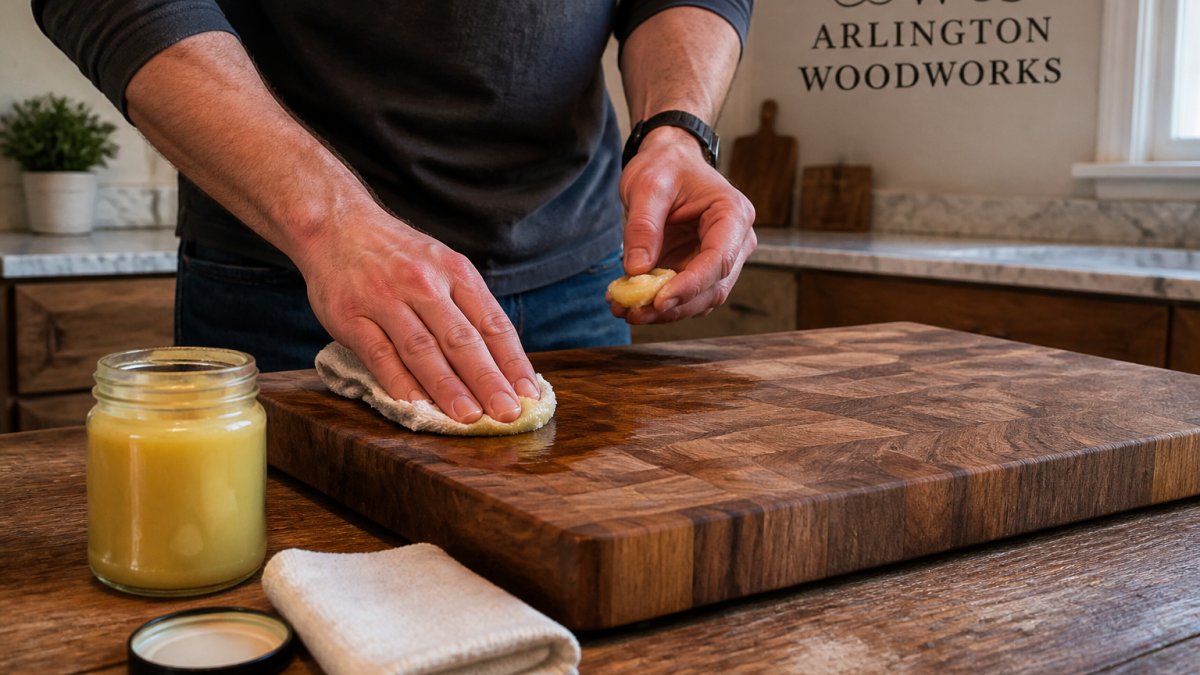
What you'll need:
- Food-grade flaxseed oil or a wood-care balm intended for food-contact surfaces
- A clean, lint-free cloth
- A clean, dry board
Step 1: Clean the board.
Remove food residue and surface grime using your normal cutting-board cleaning method.
Step 2: Let the board dry completely.
Do not apply oil to damp wood. Give the board enough time to dry all the way through the surface before conditioning it.
Step 3: Apply a small amount.
Work a thin layer of oil or balm across the surface, following the grain and paying attention to dry-looking areas.
Step 4: Let the product penetrate according to its directions.
Different products have different application and cure requirements, so follow the manufacturer’s instructions rather than relying on one universal dwell time.
Step 5: Buff away all excess.
Wipe away any product that remains on the surface so the board does not feel greasy or tacky.
Repeat the process when the board looks dry, pale, or noticeably less conditioned rather than following a rigid calendar.
How Long Does Linseed Oil Take to Dry on Wood?
There is no single dry time for every linseed- or flaxseed-oil product. The timeline depends on the formulation, how much was applied, the wood itself, and the temperature, airflow, and humidity around the piece.
The most important distinction is between dry-to-the-touch and fully cured.
A surface can feel dry while the oil underneath is still reacting with oxygen and hardening. Full cure takes longer, which is why the manufacturer’s directions should always take priority over a generic timeline.
What Affects Drying and Curing
Several factors can speed up or slow down the process:
- Coat thickness. Thin applications generally cure more predictably than heavy ones.
- Temperature. Warm conditions usually help the curing process.
- Airflow. Good ventilation supports oxidation and drying.
- Humidity. Damp conditions can slow the process.
- Product formulation. Raw oils, boiled linseed products, polymerized oils, and oil-and-wax blends can all behave differently.
How to Help It Along
- Apply thin coats rather than one heavy coat.
- Keep the piece in a warm, well-ventilated area.
- Follow the product’s instructions before applying another coat.
- Buff away excess product instead of leaving a heavy layer on the surface.
Applying another coat before the previous one has sufficiently cured can leave the surface tacky or uneven, so more is not always better.
Maintenance Intervals
Do not condition wood on a rigid calendar. Pay attention to how the surface looks and feels instead.
Signs that it may be time for another application include:
- The wood looks pale, dry, or dull.
- The surface feels noticeably drier than it did after the previous treatment.
- Frequently used areas begin to lose some of their warmth or luster.
- Knife marks or light wear become more visually noticeable against the surrounding wood.
Kitchen boards and other frequently washed surfaces will usually need attention more often than decorative furniture or low-use pieces.
Use the wood’s condition and the product directions as your guide. In most cases, applying too much product too often creates more problems than waiting until the surface actually needs care.
Safety: Oily Rags Can Self-Ignite
Rags, paper towels, steel wool, and other materials saturated with drying oils such as flaxseed, linseed, tung, walnut, and similar blends can generate heat as the oil cures.
If oily materials are crumpled together or left in a pile, that heat can build up and create a fire risk.
Handle cleanup carefully:
- Do not ball up oil-soaked rags or toss them directly into a trash can.
- Allow oily materials to dry in a safe, well-ventilated location where heat cannot build up.
- Keep them away from combustible materials while they dry.
- Follow your local fire-safety and waste-disposal guidance for oil-soaked materials.
This is not a reason to avoid drying-oil finishes. It simply means cleanup deserves the same attention as application.
Choosing a Flaxseed Oil Wood Finish: What to Look For
When choosing a flaxseed-oil product for wood, look beyond the front-label marketing and check how the product is processed, what else is in the formula, and what the manufacturer says it is designed to be used on.
What to check on the label:
- Food-grade or food-contact guidance. For cutting boards, butcher blocks, utensils, and kitchen wood, choose a product the manufacturer identifies as appropriate for that use.
- Processing method. Cold-pressed or minimally processed oils may appeal to buyers looking for a simpler, more traditional formulation.
- Ingredient transparency. A clear ingredient list makes it easier to understand exactly what you are applying to the wood.
- Added driers or solvents. These may be appropriate in some wood-finishing products, but they change how the product behaves and may affect whether it is suitable for food-contact applications.
- Intended use. A product made for decks, furniture, cutting boards, or kitchen wood may have very different performance and safety guidance even when flax or linseed oil is the primary ingredient.
You will also see terms like “pure oil,” “extra virgin,” and “organic” on labels. Those terms can describe sourcing or processing, but they do not replace the need to check the full formulation and intended use.
Our own Artisan Furniture Wood Balm No. 524 is made with certified-organic flaxseed oil, beeswax, and orange oil and comes in recyclable glass jars.
Best for
Homeowners maintaining cutting boards, utensils, furniture, and other wood surfaces who want one ready-to-use product with a short, transparent ingredient list.
One more consideration: bare and oil-finished wood generally accept conditioning oils more readily than heavily sealed surfaces. If you are unsure what finish is already on a piece, test a hidden area first and follow the surface manufacturer’s guidance.
Conclusion: Getting Flaxseed Oil Right on Wood
Getting good results with flaxseed oil comes down to three things: choosing the right product for the surface, applying it sparingly, and allowing enough time for it to cure properly.
If you would rather skip the guesswork of choosing and measuring a straight oil, our Artisan Furniture Wood Balm No. 524 combines certified-organic flaxseed oil with beeswax and orange oil in a ready-to-use wood-care blend.
Shop the full Arlington Woodworks lineup and choose the option that best fits your cutting boards, utensils, furniture, and other wood surfaces.
Frequently Asked Questions
Is flaxseed oil good for wood?
Yes. Flaxseed oil is a drying oil that can penetrate and condition bare or oil-finished wood, then gradually harden as it cures. It has a long history of use in wood care and can be appropriate for furniture, cutting boards, butcher blocks, and wooden utensils when the specific product is intended for that use. It generally works best on bare, oil-finished, or visibly dry wood. If you are unsure what finish is already on a piece, test a hidden area first.
Is flaxseed oil food safe for wood that touches food?
Food-grade flaxseed oil is commonly used on cutting boards, butcher blocks, wooden spoons, and other kitchen wood because the oil itself is edible. For food-contact surfaces, choose a product the manufacturer identifies as appropriate for that application and follow the directions for use and cure time. Artisan Furniture Wood Balm No. 524 is made with certified-organic flaxseed oil, beeswax, and orange oil and is appropriate for food-contact wood when used as directed.
How long does linseed oil take to dry on wood?
Drying time depends on the specific product, coat thickness, temperature, humidity, airflow, and the wood itself. Raw linseed oil and food-grade flaxseed oil generally cure more slowly than products formulated with added driers or other processing methods. The important distinction is that dry-to-the-touch and fully cured are not the same thing. Apply thin coats, remove excess product, and follow the manufacturer's directions before recoating or returning the piece to normal use.
Can I use organic flaxseed oil straight from the grocery store on my cutting board?
You can use a food-grade flaxseed oil on a wooden cutting board if the product is appropriate for that use, but straight oil requires more attention to application, storage, and cure time. Start with a clean, completely dry board, apply a small amount, remove the excess, and follow the product's directions before returning the board to regular use. A purpose-made wood-care product such as No. 524 can simplify the process by combining certified-organic flaxseed oil with beeswax and orange oil in a ready-to-use formulation.


