

Food Safe Mineral Oil for Cutting Board Care, Explained
Last Updated: November 19, 2026
Quick Summary
Mineral oil is traditionally used to condition wooden cutting boards, butcher blocks, and other unfinished wood surfaces. Food-grade mineral oil is highly refined and can be appropriate for cutting boards when the product is specifically intended for food-contact use.
However, mineral oil is petroleum-derived and non-drying, meaning it does not cure into a hardened finish. It conditions wood but requires periodic reapplication as it gradually washes or wears away.
For those seeking a plant-based alternative, natural drying oils and beeswax-based wood balms offer a different approach to wood care. These formulations can provide conditioning and surface protection, depending on their ingredients, intended applications, and curing characteristics.
Key Takeaways:
- Food-grade mineral oil is a legitimate option for conditioning wooden cutting boards.
- Mineral oil does not cure or create a permanent protective finish.
- Beeswax and plant-based oils offer alternative approaches to conditioning and protecting wood.
- Not every wood-care product is suitable for direct food-contact surfaces.
- The best treatment depends on the wood's existing finish, intended use, and maintenance requirements.
Table of Contents
- What Food Safe Mineral Oil Is and What It Is Not
- Why Mineral Oil Works on Wood Cutting Boards
- How to Oil a Cutting Board Step by Step
- How Often to Oil a Cutting Board
- Mineral Oil vs Beeswax for Cutting Boards
- Choosing a Food-Safe Wood Finish for Cutting Boards
- Matching the Product to Your Board and Your Routine
- Frequently Asked Questions
What Food Safe Mineral Oil Is and What It Is Not
Mineral oil is a highly refined, petroleum-derived oil traditionally used to condition wooden cutting boards, butcher blocks, utensils, and other unfinished wood surfaces. It helps restore the appearance of dry wood while reducing moisture absorption during everyday use.
Food-grade mineral oil is specifically refined to meet applicable purity requirements. When a product is intended for cutting boards or food-contact surfaces, it can be a suitable option for routine wood maintenance.
However, mineral oil has an important limitation: it is a non-drying oil. Unlike certain natural plant-based oils, mineral oil does not polymerize or cure into a hardened finish. Instead, it remains within the wood and gradually wears or washes away, requiring periodic reapplication.
Mineral oil also serves a different purpose from cleaning, repairing, or refinishing wood. It can improve the appearance and feel of a dry wooden surface, but it cannot repair cracks, remove deep scratches, sanitize a cutting board, or restore a damaged finish.
For homeowners interested in alternatives to petroleum-derived mineral oil, plant-based drying oils and beeswax formulations provide another approach to wood conditioning and protection. The appropriate choice depends on the wood surface, its existing finish, and whether it will come into direct contact with food.
How Food-Grade White Mineral Oil Is Refined
Food-grade white mineral oil begins as a petroleum-derived fraction that undergoes extensive refining to remove impurities, color, and unwanted compounds. The result is a clear, odorless, and tasteless oil with consistent properties.
Although mineral oil originates from petroleum, highly refined food-grade mineral oil can be suitable for cutting boards and other food-contact surfaces when the specific product meets applicable requirements and is intended for that use.
Unlike natural plant-based drying oils, mineral oil does not undergo a curing process after application. It remains liquid within the wood, providing conditioning without forming a hardened protective finish.
This distinction is important when comparing mineral oil with alternatives such as flaxseed oil and beeswax-based wood treatments. Each behaves differently, and the best option depends on the surface being treated and its intended use.
How to Verify Food-Contact Suitability Before You Buy
Not every product labeled "mineral oil" is intended for use on cutting boards or other food-contact surfaces. Before purchasing mineral oil for wood care, verify that the manufacturer identifies the product as suitable for its intended application.
Here are four things to look for:
- A clearly identified grade. Look for terms such as "food-grade mineral oil" or "white mineral oil." A USP designation may indicate compliance with pharmaceutical purity standards, but it does not automatically establish suitability for every food-contact application.
- An intended-use statement. Choose a product specifically labeled for cutting boards, butcher blocks, wooden utensils, or other food-contact surfaces.
- A reputable manufacturer. Look for a clearly identified manufacturer or supplier that provides product specifications and application instructions.
- Supporting documentation. Product specification sheets can help clarify purity and intended applications. Commercial buyers may also request a Safety Data Sheet (SDS), although an SDS alone does not certify food-contact suitability.
If a product does not clearly identify its grade or intended use, choose one that does.
Remember that food-grade mineral oil and natural wood-conditioning oils are different categories of products. Whether you prefer petroleum-derived mineral oil or a plant-based alternative, always verify that the specific formulation is appropriate for the surface and its intended use.
Food-Grade Versus Industrial Mineral Oil
Although both products share the name "mineral oil," food-grade and industrial mineral oils are not interchangeable.
Food-grade mineral oil undergoes refining to meet specific purity requirements. Products formulated and labeled for cutting boards, butcher blocks, and wooden utensils are intended for use on surfaces that may come into contact with food.
Industrial mineral oil, on the other hand, may be formulated for machinery, equipment lubrication, or other applications where food-contact suitability is not required. These products may contain additives or impurities that make them inappropriate for cutting-board maintenance.
The same caution applies to mineral oil sold for cosmetic or medicinal purposes. Although these products may be highly refined, their labeling does not necessarily establish suitability for treating food-contact wood surfaces.
The practical rule: Choose a mineral oil specifically intended for cutting boards or other food-contact wooden surfaces, and follow the manufacturer's application instructions.
For those who prefer to avoid petroleum-derived ingredients altogether, plant-based oils and natural wax formulations provide alternative approaches to wood conditioning. However, natural ingredients alone do not guarantee that a finished product is appropriate for direct food contact.
Why Mineral Oil Works on Wood Cutting Boards
Mineral oil works on wooden cutting boards because it penetrates the wood's surface, helping reduce moisture absorption and maintain the appearance of dry, unfinished wood.
When applied properly, mineral oil can enhance the wood's natural color, improve its surface feel, and help limit rapid moisture changes during everyday use.
However, mineral oil is a non-drying oil, meaning it does not polymerize or cure into a hardened protective finish. Instead, it remains liquid within the wood and gradually diminishes through washing, handling, and regular use.
This characteristic offers both advantages and limitations. Mineral oil is relatively simple to apply and maintain, but it requires periodic reapplication because it does not create a durable, cured coating.
Natural drying oils, such as properly prepared flaxseed oil, behave differently. They can undergo oxidation and polymerization, gradually forming a more persistent finish as they cure. Beeswax-based formulations can also contribute surface protection by helping repel moisture.
Understanding these differences is useful when choosing between mineral oil, natural oils, and wood-conditioning balms for different wooden surfaces.
Non-Drying Means It Stays Workable, Not Permanent
Unlike natural drying oils, mineral oil does not cure or harden after application. It remains liquid within the wood, helping maintain its appearance and reducing moisture absorption without forming a permanent protective finish.
This makes mineral oil easy to reapply, but it also means the treatment gradually wears away through regular use, washing, and exposure to moisture.
For wooden cutting boards that receive frequent use, this can mean more regular conditioning to maintain their appearance and moisture resistance.
By comparison, natural drying oils such as flaxseed oil can polymerize as they cure, creating a more persistent finish. Beeswax can also contribute a moisture-resistant surface layer, although wax itself does not cure into a hardened film.
The key difference is longevity and maintenance. Mineral oil provides straightforward conditioning that must be replenished, while properly formulated drying oils and wax-based treatments offer different approaches to protecting wood over time.
If you are also weighing board materials and how they hold up in a kitchen, our comparison of butcher block vs granite countertops covers the durability side of that decision.
How to Oil a Cutting Board Step by Step
Applying food-grade mineral oil to a wooden cutting board is a straightforward way to maintain its appearance and help reduce moisture absorption. Proper preparation and application are important for achieving an even result without leaving the surface greasy.
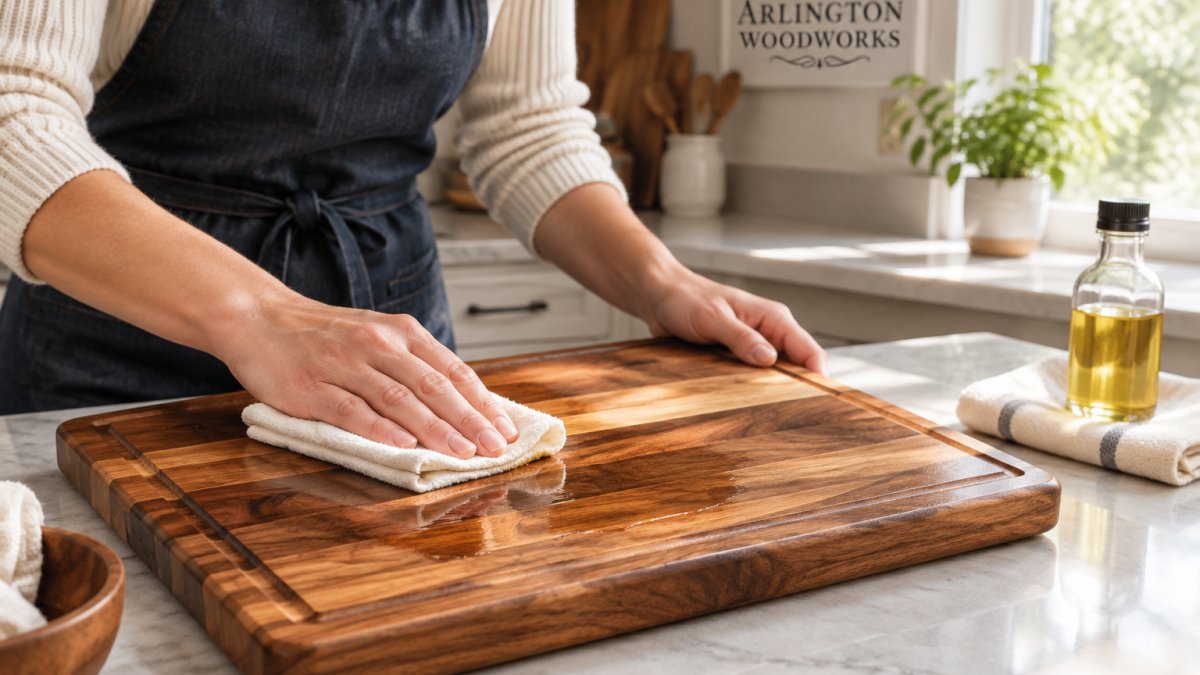
Follow these six steps:
- Clean the cutting board. Wash the board with mild dish soap and warm water, then allow it to dry completely before applying oil.
- Prepare your workspace. Place the dry board on a clean towel or protective surface to catch any excess oil.
- Apply a small amount of mineral oil. Using a clean, lint-free cloth, spread food-grade mineral oil evenly across the wood, including the edges and end grain.
- Allow the oil to absorb. Follow the manufacturer's recommended absorption time so the oil can penetrate the wood's surface.
- Remove excess oil. Buff the entire board with a clean, dry cloth until no visible oil remains on the surface.
- Inspect before use. Make sure the board feels clean and free of excess oil before returning it to regular kitchen use.
Avoid overapplication. Adding more mineral oil than the wood can absorb does not necessarily improve protection. Excess oil can leave the surface feeling greasy and attract dust or debris.
For best results, always follow the oil manufacturer's directions and reapply based on the cutting board's condition rather than an arbitrary schedule.
If you are applying a balm rather than a plain oil, our step-by-step guide to applying Arlington Woodworks No. 524 walks through the same sequence with product-specific directions.
How Often to Oil a Cutting Board
How often you should oil a wooden cutting board depends on how frequently it is used, how it is cleaned, and the condition of the wood.
There is no universal maintenance schedule. A cutting board used and washed daily may require conditioning more frequently than one used occasionally.
Because mineral oil does not cure into a hardened finish, it gradually wears or washes away. Regularly inspecting your cutting board is the most reliable way to determine when another application is needed.
Signs your cutting board may need oiling include:
- A dry or faded appearance. The wood looks noticeably lighter, duller, or chalky compared with its conditioned appearance.
- Increased moisture absorption. Water absorbs into the surface more readily than it previously did.
- A rough texture. The wood feels slightly raised or fuzzy after washing and drying.
- Dry-looking edges or end grain. These areas may show signs of dryness before the rest of the board.
For most households, checking the board every few weeks is a reasonable starting point. Apply additional mineral oil when its condition indicates that conditioning is needed, following the manufacturer's instructions.
Remember: Mineral oil helps maintain the appearance and moisture resistance of wooden cutting boards, but it does not repair cracks, eliminate deep scratches, or replace proper cleaning and sanitation.
If you have applied oil or balm and the surface feels sticky afterward, that is usually excess product rather than a wood problem. Our explanation of why wood furniture feels tacky after oiling covers the cause and the fix.
Mineral Oil vs Beeswax for Cutting Boards
Feature |
Food-Grade Mineral Oil |
Beeswax or Oil-Wax Balm |
|---|---|---|
Primary purpose |
Conditions wood |
Provides surface protection; blended oils may also condition |
Penetration |
Absorbs into wood |
Wax remains primarily near the surface |
Curing |
Does not cure or harden |
Beeswax does not cure; certain blended oils can |
Moisture resistance |
Helps reduce absorption |
Adds a water-resistant surface layer |
Maintenance |
Reapply as needed |
Reapply as the protective layer wears |
Food-contact suitability |
Depends on the specific product |
Depends on the specific formulation |
Best application |
Routine conditioning of unfinished wood |
Conditioning and surface protection where compatible |
The key takeaway: Mineral oil is a practical choice for straightforward wood conditioning, while beeswax and properly formulated oil-wax blends provide a different approach that combines conditioning with surface protection.
Neither option replaces proper cutting-board cleaning, sanitation, or maintenance.
The Trade-Offs That Actually Matter
When choosing between mineral oil and beeswax-based wood treatments, the most important differences come down to appearance, maintenance requirements, and the type of protection each product provides.
Appearance and surface feel. Mineral oil enhances the natural color of wood and generally leaves a subtle, low-sheen appearance after excess oil is removed. Beeswax can provide a smoother surface feel and a soft sheen, depending on the formulation and application.
Maintenance requirements. Because mineral oil does not cure, regular washing and use gradually remove it from the wood. Beeswax-based treatments also require periodic maintenance as their protective layer wears away. Formulations containing natural drying oils may behave differently because those oils can polymerize as they cure.
Moisture protection. Both mineral oil and beeswax can help reduce moisture absorption, but they accomplish this differently. Mineral oil penetrates the wood, while beeswax forms a thin, water-resistant surface layer. Neither treatment makes a wooden cutting board waterproof.
Cleaning and sanitation. Neither mineral oil nor beeswax cleans, sanitizes, or disinfects wood. Proper washing, drying, and food-handling practices remain essential regardless of the conditioning product used.
Ultimately, the right choice depends on how the wooden surface is used, the finish already present, and the level of maintenance you are comfortable performing.
Why Someone Might Reasonably Prefer Either
Choosing between mineral oil and a natural wood-conditioning balm comes down to personal preferences, the type of wood being treated, and how the surface will be used.
Food-grade mineral oil is a practical choice for wooden cutting boards and butcher blocks when you want a straightforward, non-drying conditioner. It is widely available, easy to apply, and can be replenished whenever the wood begins to look dry.
Natural oil-and-wax balms offer a different approach for homeowners who prefer plant-based ingredients and want both wood conditioning and surface protection.
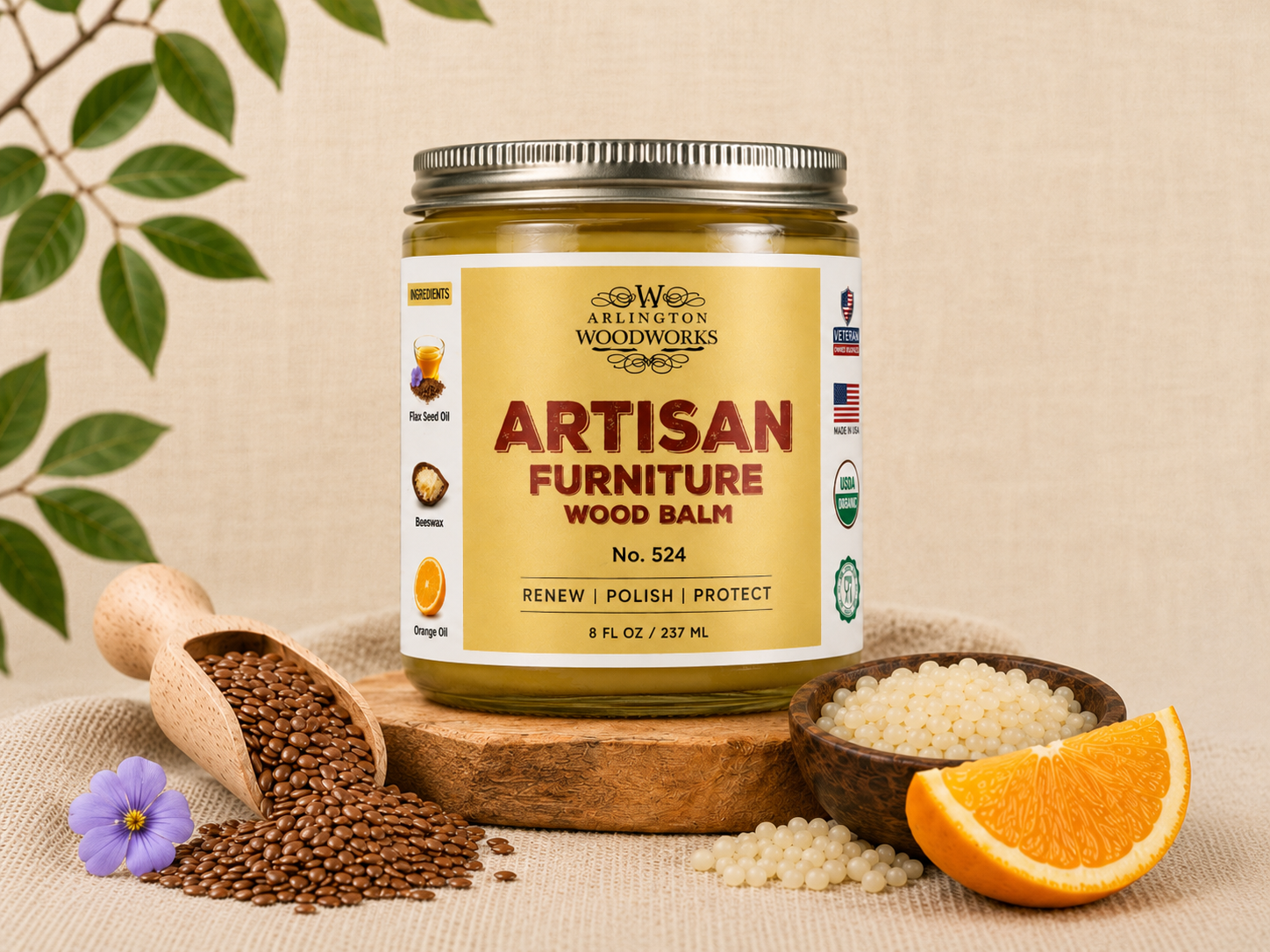
At Arlington Woodworks, we make Artisan Furniture Wood Balm No. 524 using beeswax, organic flaxseed oil, and orange oil. This combination is designed to condition and protect compatible wood finishes while enhancing the wood's natural appearance.
Unlike mineral oil, flaxseed oil is a drying oil that can polymerize as it cures. Beeswax contributes a moisture-resistant surface layer, while orange oil is included in the formulation.
No. 524 is formulated for furniture and compatible wooden surfaces. Before using any conditioning balm on cutting boards or other direct food-contact surfaces, verify that the finished product is specifically suitable for that application and follow its directions.
The best choice isn't necessarily mineral oil or beeswax for every situation. It is the product that matches your wood, your maintenance preferences, and how the surface will be used. For a closer look at beeswax specifically, our article on whether beeswax is safe for food contact goes deeper on the food-safety question.
Choosing a Food-Safe Wood Finish for Cutting Boards
Choosing the right wood finish starts with understanding how the surface will be used. A wooden cutting board that regularly comes into contact with food has different maintenance requirements than a dining table, cabinet, or decorative wooden surface.
For cutting boards, the most important considerations are food-contact suitability, moisture resistance, ease of cleaning, and maintenance.
Food-grade mineral oil is a traditional option for conditioning unfinished wooden cutting boards. It helps reduce moisture absorption without forming a hardened finish, making it relatively easy to replenish as needed.
Beeswax and oil-wax blends can provide additional surface protection while enhancing the wood's natural appearance. However, the finished formulation must be appropriate for food-contact use, not simply made with ingredients that are individually considered food-safe.
Natural drying oils, including properly formulated flaxseed oil, offer another approach to wood finishing. Unlike mineral oil, drying oils can polymerize as they cure. Their suitability for cutting boards depends on the specific formulation, intended application, and required curing conditions.
For furniture, cabinetry, and other compatible wooden surfaces that do not require direct food-contact suitability, products such as Artisan Furniture Wood Balm No. 524 offer a plant-based conditioning alternative.
The most important principle is to match the wood-care product to the surface rather than assuming one treatment works for every application.
Before applying any oil, wax, or balm, review the manufacturer's instructions and confirm compatibility with the existing finish.
Matching the Product to Your Board and Your Routine
The best wood-care product depends on how frequently the surface is used, its existing finish, and the level of maintenance you prefer.
A wooden cutting board used daily requires a different approach than a decorative butcher block, dining table, or antique wooden cabinet.
Here are some practical recommendations:
- Frequently used cutting boards: Choose a food-contact-appropriate conditioning oil, such as food-grade mineral oil specifically labeled for cutting boards. Reapply as needed based on the wood's condition.
- Cutting boards needing additional surface protection: Consider a beeswax-based board conditioner specifically formulated for food-contact use. Oil-and-wax blends can help condition wood while providing a moisture-resistant surface layer.
- Furniture and decorative wooden surfaces: A natural wood-conditioning balm such as Artisan Furniture Wood Balm No. 524 can help condition compatible wood finishes while enhancing their appearance.
- Previously finished or coated wood: Identify the existing finish before applying additional products. Some film-forming finishes may not absorb conditioning oils or waxes as unfinished wood does.
- Antique or heirloom furniture: Begin with the least-invasive maintenance approach and seek professional guidance before applying treatments that could alter an original finish.
If you're evaluating different countertop materials, our guide to butcher block vs. granite countertops explores some of the practical differences in durability and maintenance.
The bottom line: Mineral oil, beeswax, and natural drying oils each have legitimate applications. Choosing the right product means understanding what the wood needs and selecting a treatment designed for that purpose.
Most cutting board problems are not product problems. They are mismatches between the job and the product, or between the product and the finish already on the wood.
Frequently Asked Questions
Is food-grade mineral oil actually safe for a cutting board?
Yes. Food-grade mineral oil is highly refined and can be suitable for conditioning wooden cutting boards when the specific product is intended for food-contact use. Unlike industrial mineral oil, food-grade mineral oil must meet applicable purity requirements. Always select a product labeled for cutting boards or other food-contact wooden surfaces and follow the manufacturer's application instructions.
How often should you oil a wooden cutting board?
Oil a wooden cutting board whenever the surface begins to look dry, faded, or noticeably rough. A board used and washed daily may need more frequent conditioning than one used occasionally. Checking the wood every few weeks is a reasonable starting point, but its condition should determine when additional oil is necessary.
Can you use olive oil instead of food safe mineral oil on a cutting board?
Olive oil and other common cooking oils are generally not recommended for routine cutting-board conditioning because they can oxidize and develop unpleasant odors over time. Food-grade mineral oil is a stable, non-drying alternative traditionally used for wooden cutting boards. If you prefer a plant-based treatment, choose a product specifically formulated and labeled for food-contact wood surfaces.
Is mineral oil better than beeswax for cutting boards?
Neither is universally better because mineral oil and beeswax serve different purposes. Mineral oil penetrates wood to provide conditioning and help reduce moisture absorption. Beeswax contributes a thin, water-resistant surface layer that can enhance the wood's appearance and feel. Some cutting-board conditioners combine oils and beeswax to provide both benefits. The best choice depends on the specific formulation and your maintenance preferences.
Can you use a beeswax balm on a cutting board that has been oiled with mineral oil?
Often, yes. Many cutting-board conditioners combine mineral oil and beeswax, so these ingredients are generally compatible. However, a board heavily saturated with mineral oil may not absorb additional products evenly. Clean and dry the surface, remove excess oil, and apply a small amount of a beeswax conditioner specifically intended for food-contact use. Always follow the manufacturer's instructions, particularly when using formulations containing drying oils or other ingredients.


